Buying guides
Kitchen Lead Times Explained for Factory-Direct Orders
Key points
- Kitchen lead times run from approved specification to delivery, not from the first enquiry.
- Most delays happen before production: late drawings, open options and slow sample sign-off.
- Production, inspection, sea freight, customs and haulage each take their own time.
- Agree the lead time in writing against an approved schedule, then plan phased call-offs.
- Order the first phase early and lock options at a fixed point in the build programme.
Ask a supplier for kitchen lead times and you will often get a single number. On a factory-direct order for a housing scheme or a large project, that number is really the sum of several stages, some controlled by the factory and some by you. Understanding each stage is the best way to make sure kitchens arrive when the plots are ready, not before and not after.
This guide explains what sits inside a factory-direct lead time, where projects usually lose time and how to plan around it.
When do kitchen lead times actually start?
A lead time does not start with the first enquiry or the first quotation. It starts when the factory has everything it needs to make the kitchens without asking another question. In practice that means:
- a final, coded schedule for each house or apartment type;
- confirmed door styles, colours, handles and panel finishes;
- approved samples;
- agreed quantities and a first delivery phase;
- a signed order with the delivery basis agreed (EXW, FOB, CIF or DDP).
If any of these is still open, the clock has not really started. The most common reason a factory-direct order "runs late" is that it began later than everyone assumed.
The stages inside a factory-direct lead time
| Stage | What happens | Who controls it |
|---|---|---|
| 1. Specification | Plans turned into coded unit schedules and an itemised quotation | You and the supplier |
| 2. Samples | Doors, colours, handles and a carcass sample approved | Mostly you |
| 3. Production | Boards cut, edged, finished, assembled and packed | The factory |
| 4. Inspection | Sizes, finish, hardware and labels checked before loading | The factory, plus any third-party inspector you appoint |
| 5. Sea freight | Containers loaded, shipped and discharged at a UK port | The shipping line and forwarder |
| 6. Customs and haulage | Import clearance, then delivery to your warehouse or site | Your forwarder or the supplier, depending on the delivery basis |
Our ordering process follows the same six steps: send your plans, receive a quotation, approve samples, manufacture, inspection and delivery.
Where projects lose time
Production and shipping are rarely where the weeks disappear. Time is usually lost at the start:
- Late or changing drawings. Each revision to a house type means a revised schedule and quotation.
- Open buyer options. If colour choices stay open until just before handover, the order cannot be placed.
- Slow sample sign-off. Samples sitting on a desk for a fortnight add a fortnight to every phase.
- Unclear delivery basis. If nobody has agreed who books freight and clears customs, the goods can wait at the port.
Each of these is avoidable with a fixed decision point in the programme. We cover how to structure the specification in new build kitchen specification for 100 plots.
Production: what affects it
Inside the factory, time depends on the order rather than the calendar. The main factors are:
- Volume and mix: many identical units run faster than many different ones.
- Finish: painted solid-wood doors take longer than melamine or thermofoil slab doors.
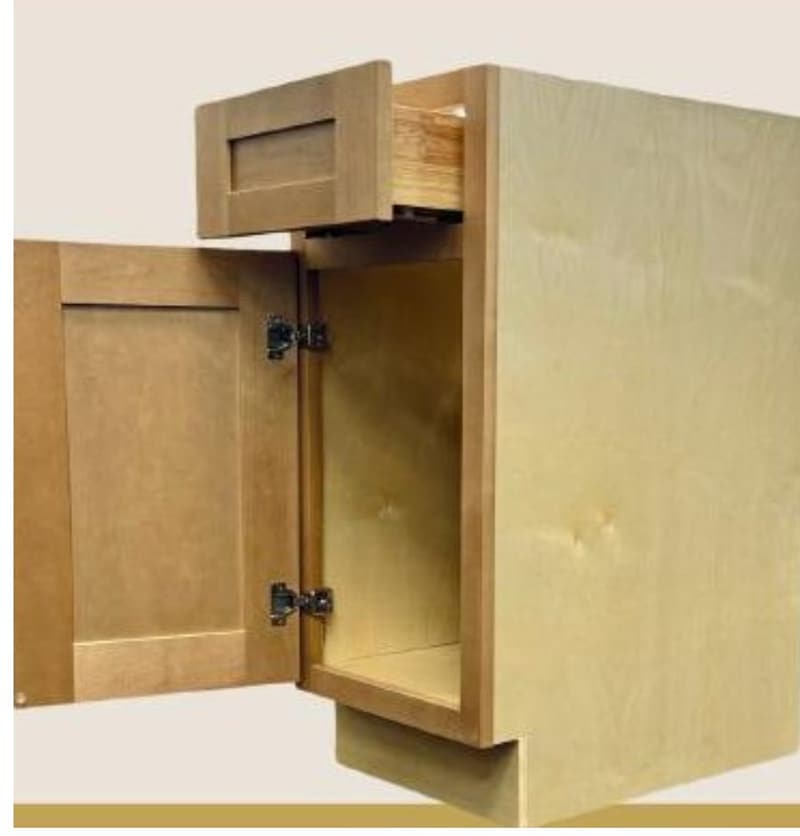
- Construction: some of our builds ship one box per cabinet; Flex and Frameless ship the carcass with a separate front set. See our cabinet constructions.
- Special items: non-standard sizes, curved panels or bespoke colours need extra preparation.
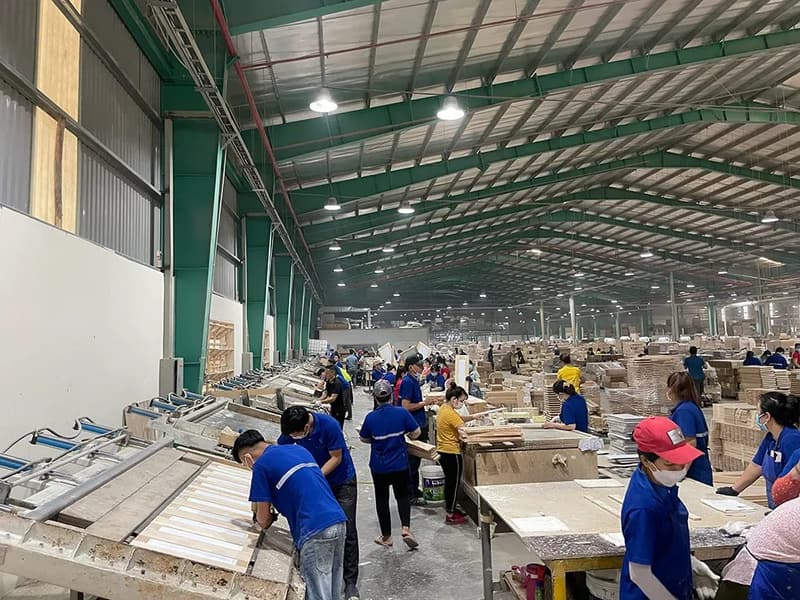
Because we manufacture in our own factories in China, Vietnam and Thailand and ship 500+ containers a month to the US, phased production for housing programmes is routine for us. The production time for your order is confirmed in writing with the quotation.
Shipping, customs and delivery
Once containers are loaded, the timetable belongs to the shipping line. Transit times vary by origin port, route and season, and holidays at either end (for example Chinese New Year) affect sailings. Then the goods need customs clearance and haulage to your warehouse or site.
Who manages this depends on the delivery basis. Under FOB, you appoint the forwarder from the port of loading; under DDP, the supplier delivers to your door with duties paid. The trade-offs are explained in Incoterms for kitchen buyers, and our shipping and delivery page covers how phased container loads reach UK sites.
How to plan around lead times
- Work backwards from the first fit date. Add delivery, customs, shipping, inspection, production and approvals in turn to find when the order must be signed.
- Lock options early. Set a cut-off for buyer choices at a fixed point in the build programme and order each phase straight after it.
- Approve samples once. Approve a full sample set and a first kitchen at the start, then call off later phases against the same approval.
- Phase the call-offs. Order in phases tied to plot completion, so kitchens are not stored on site for months.
- Agree it in writing. Ask for the lead time per phase to be written into the order against the approved schedule.
- Keep a small buffer stock. A few spare doors and common units per house type cover site damage without waiting for the next container.
Factory-direct versus stock kitchens
Stock kitchens from a local distributor can arrive quickly, which suits a one-off replacement. For a development, the longer chain of a factory-direct order buys consistency (every kitchen from the same production), a full choice of doors and finishes, and the removal of a distributor margin from every plot. Planned properly, the lead time is a line in the programme rather than a risk.
Frequently asked questions
What are typical kitchen lead times for a factory-direct order?
They are the sum of approvals, samples, production, inspection, sea freight, customs and delivery. Production and delivery depend on the order, so ask for the lead time per phase in writing against an approved schedule.
When does a kitchen lead time start?
When the factory has a final coded schedule, confirmed finishes, approved samples, agreed quantities and a signed order. Open choices mean the clock has not really started.
What causes delays on kitchen orders?
Most delays happen before production: changing drawings, buyer options left open, slow sample approval and an unclear delivery basis.
How can developers avoid waiting for kitchens?
Work backwards from the first fit date, lock buyer options at a fixed point, approve samples once and call off kitchens in phases that match plot completions.
About the author. Written by Sanyang's design and technical team, drawing on more than 25 years of manufacturing kitchen and bathroom cabinetry and more than 500 containers a month shipped to the United States. About Sanyang.